
18 July 2026
Football Trophies and Engraved Gifts: A Trade Guide to the 2026 Presentation Season
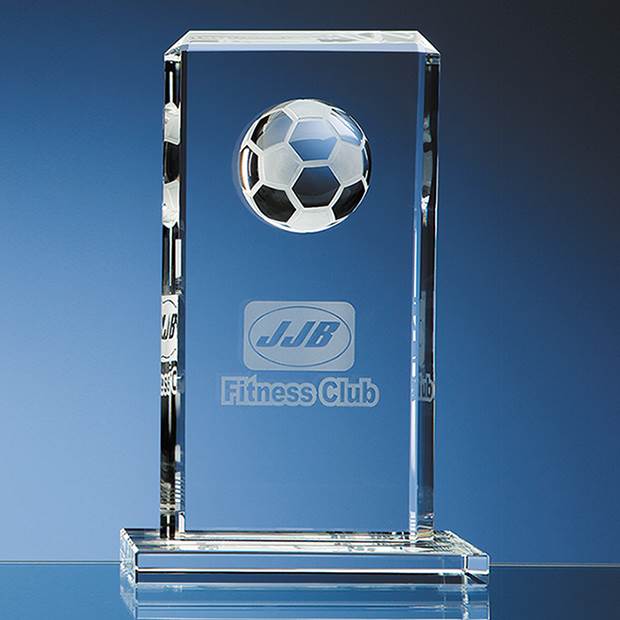
A major international football tournament does not just sell replica shirts. For anyone supplying football trophies, awards and engraved gifts, the commercially useful window opens the week the tournament ends and stays open through the following season. This guide covers why that happens, what you can legally brand, and which product categories to have on the shelf.
Why a tournament summer moves awards and glassware
The pattern is consistent after every major international football tournament. Grassroots participation rises, new clubs and junior sides form, and existing clubs find themselves with larger squads than they planned for. Each of those changes lands in the awards trade eventually, usually one to two seasons later.
Three demand drivers follow a tournament summer:
- New and expanded clubs. A club that adds two junior age groups needs two more sets of end-of-season awards, plus a manager's gift and often a new perpetual trophy.
- Presentation nights. UK grassroots seasons typically close between April and June, so orders placed for the season starting this autumn are presented next spring. That is a long, plannable lead time.
- Corporate and hospitality tie-ins. Businesses that ran tournament-themed client events want a keepsake. Engraved tankards and tumblers do that job better than printed merchandise, because they survive the news cycle.
What can you actually brand around a tournament?
This is the question most likely to catch a reseller out, so it is worth being precise.
Governing bodies register their tournament names, emblems, mascots and trophy designs as trademarks, and they enforce them. Using those marks to sell a product — or designing something that implies an official association — creates real legal exposure, even for a small order. Replicating the shape of an official trophy is a separate risk again, because trophy designs are themselves protected.
What is generally safe: generic football imagery, a club's own crest and colours, player names and squad numbers for that club, dates, and descriptive wording such as "2026 Season" or "Player of the Year".
What is not: tournament names and logos, official emblems and mascots, and any design that copies a recognised official trophy. If a customer sends artwork containing a governing body's mark, the safe answer is to ask whether they hold a licence before the job goes to engraving.
The practical takeaway: build the offer around the club, not the tournament. Club-branded product is legally clean, carries higher perceived value, and repeats every single season.
Five categories worth stocking for presentation season
1. Football-specific crystal awards
The obvious anchor product. A sculpted or optical crystal football award reads unmistakably as a sporting trophy without borrowing anyone's branding. Our 24cm Optical Crystal Football Rectangle Award (SY1036) gives a large flat engraving panel alongside the football motif, which matters when a club wants a crest, a name and a season on the same piece.
2. Football-base drinkware
The strongest margin category for volume club orders, because it works as both an award and a gift. The 1pt Handmade Football Base Beer Tankard (L316) is the classic manager's and captain's gift; the half-pint version (L317) suits junior presentations and mixed-age squads, and the 10oz Football Base Whisky Tumbler (L314) covers the same brief for non-beer drinkers.
3. Plain optical crystal awards
Do not overlook the unthemed ranges. Clubs frequently want a single design across every category — Top Scorer, Most Improved, Clubman of the Year — and a rectangle award scaled across sizes handles that neatly. Our optical crystal rectangles run from 10cm x 15cm (SY5083) through 12.5cm x 17.5cm (SY5084) to 15cm x 20cm (SY5085), letting a club signal hierarchy through size while keeping one artwork setup.
4. Paperweights and desk pieces
The right answer for sponsor thank-yous, committee gifts and volunteer recognition, where a large trophy would be the wrong register. Lower unit cost also makes them viable for the long tail of a club's recognition list, which is usually where budgets run out.
5. The perpetual trophy
Higher value, ordered once, engraved every year afterwards. A club that buys a perpetual award from you returns annually for the re-engraving, which turns a single transaction into a recurring one. Worth leading with in any club conversation.
Common questions
When should a club order its end-of-season awards?
Eight to ten weeks before the presentation night. Personalised engraving needs artwork approval, proofing and production time, and spring is the busiest period in the awards calendar. Clubs that order in January for a May presentation get the widest choice; clubs that order in April get whatever is in stock.
What is the difference between optical crystal and lead crystal?
Optical crystal is lead-free, exceptionally clear, and typically moulded or cut into geometric award shapes — it is the standard material for modern trophies. Lead crystal contains lead oxide, which adds weight and light refraction, and is more common in traditional drinkware such as decanters and tankards. For awards, optical crystal is usually the right specification.
Can you engrave a club crest, or only text?
Full crests are standard. Sandblast engraving reproduces detailed line work well, and colour decal printing handles multi-colour badges where an engraved crest would lose the club's colours. Supply artwork as vector where possible.
What is a realistic budget per award for a grassroots club?
Most junior presentation orders sit between £8 and £30 per piece, with one or two headline trophies at a higher value. Building a tiered offer around that range — volume pieces plus a small number of premium awards — matches how club budgets are actually structured.
Are football-themed awards only useful during a tournament year?
No. Domestic club seasons run every year regardless of international fixtures, and presentation nights are an annual fixture. A tournament summer raises the baseline by bringing new participants into the sport; it does not create the demand from nothing.
Planning your season
The clubs placing orders next spring are forming their committees now. Supplier conversations started in late summer convert far more reliably than ones started in March, when the club has already decided what it can afford.
Explore the full range of sports awards and engravable gifts, or contact the team to discuss volume pricing and lead times for club orders.